Table of Contents
ONE-KRATOM.COM, For a high-volume distributor or brand owner, the kratom supply chain can feel like a high-stakes gamble. When you are importing tons of botanicals across oceans, a single mistake by an inexperienced overseas supplier can mean tens of thousands of dollars seized at customs, contaminated product recalls, or months of delayed inventory.
In the B2B botanical space, trust isn’t just a buzzword—it is the foundation of your profit margins. To safeguard your business, you must know how to spot and eliminate vulnerabilities in your supply chain.
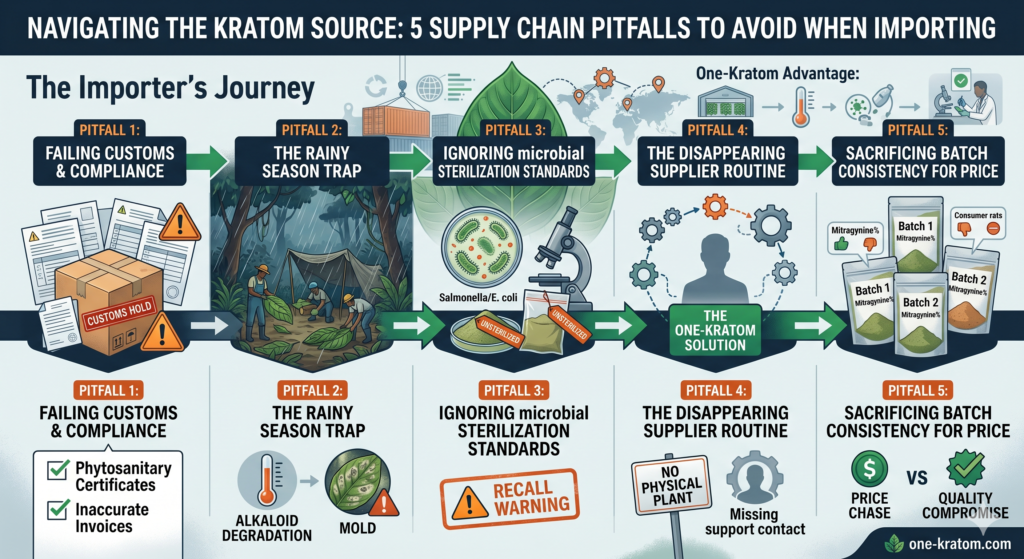
Here are the 5 critical supply chain pitfalls of kratom importing, and how to bulletproof your logistics against them.
1. Failing the Customs & Compliance Checklist
The fastest way to ruin an import budget is an unexpected seizure or hold at the port of entry. Customs officials do not tolerate incomplete, vague, or improper documentation. If your supplier treats paperwork as an afterthought, your shipment is a ticking time bomb.
The Bulletproof Documentation Toolkit
To ensure smooth transit through international ports, every single shipment must be accompanied by a pristine compliance packet:
Phytosanitary Certificate: Issued by the exporting country’s department of agriculture, proving the plant material has been inspected and is free from quarantine pests.
Detailed Bill of Lading (BoL): Accurately detailing the weight, volume, and exact shipping terms (FOB, CIF, etc.).
Compliant Labeling & Commercial Invoice: Clear, transparent declarations that match the harmonized tariff codes exactly. No vague descriptions or missing manufacturer details.
The One-Kratom Advantage: We handle international logistics daily. Our dedicated compliance team ensures every document is double-checked and pre-cleared before the container ever leaves port, minimizing red tape and preventing costly delays.
2. Falling into the “Rainy Season” Trap
Southeast Asia’s tropical climate is perfect for growing Mitragyna speciosa, but it can wreak havoc on harvesting and drying if a supplier relies on primitive methods.
During the heavy monsoon seasons, amateur suppliers dry their harvested leaves outdoors under tarps or on open ground. This introduces two fatal flaws:
Alkaloid Degradation: Excess moisture and lack of temperature control cause the active alkaloids (like mitragynine) to degrade rapidly, leaving you with a weak, low-potency product.
Mold and Moisture Spikes: Packing powder that has even a fraction of excess moisture into sealed ocean containers creates a breeding ground for mold and mildew during the hot, humid weeks at sea.
[Outdoor Monsoon Drying] --> High Moisture --> Mold Growth & Low Alkaloids (High Risk)
[Indoor Climate Control] --> Stable Heat   --> Maximum Potency & Sterile Powder (Safe)
The Solution:
Never buy from a vendor that relies solely on sun-drying. Ensure your partner uses state-of-the-art indoor, climate-controlled drying facilities that maintain strict temperature and humidity parameters year-round, regardless of the weather outside.
3. Ignoring Microbial Sterilization Standards
Raw agricultural products are naturally exposed to dirt, birds, and wildlife. Without rigorous, industrial-grade sterilization, raw kratom powder poses a severe risk for foodborne pathogens like Salmonella and E. coli. A single positive test on your end can force a catastrophic product recall that destroys your brand’s reputation overnight.
When vetting an export partner, ask explicitly about their pasteurization protocols.
Dry-Heat Sterilization: Utilizing controlled, high-temperature dry heat to neutralize microbial threats without compromising the delicate alkaloid profile.
Gamma Irradiation: The gold standard for global botanical sterilization, completely eliminating pathogens while preserving the color, aroma, and efficacy of the powder.
If a supplier cannot provide third-party, pre-shipment lab results certifying a clean microbial analysis, do not wire them a single dollar.
4. Accepting the “Disappearing Supplier” Routine
The global kratom market is flooded with middle-men, brokers, and fly-by-night brokers who operate out of a smartphone with no physical infrastructure. They promise impossibly low prices, take a large deposit, and then become completely unresponsive when a harvest is late, or a batch fails inspection.
A reliable B2B partner must have institutional permanence. They should have verified physical processing plants, transparent corporate structures, and a tracking system that allows you to see exactly where your order sits in the production pipeline.
5. Sacrificing Batch Consistency for Cheap Pricing
In the retail market, your customers expect the “Green Maeng Da” they buy today to feel exactly the same as the batch they bought three months ago. However, raw trees vary wildly from leaf to leaf.
Cheap suppliers simply grind whatever leaves they have, throw them into a bag, and ship them. This leaves you with erratic potency from batch to batch, leading to customer complaints and returns.
Premium importers look for suppliers who practice homogenization and blending precision. By testing individual lots for alkaloid percentages and precisely blending them in commercial mixers, a professional exporter can guarantee an exact, consistent mitragynine percentage across an entire multi-ton order.
Secure Your Supply Chain with One-Kratom
At One-Kratom, we have systematically engineered every vulnerability out of the import process. We don’t just ship botanicals; we manage risk so you can scale your business with absolute peace of mind.
Pristine Documentation: 100% audit-ready customs and compliance paperwork with every order.
Advanced Processing: Year-round, indoor climate-controlled drying and rigorous sterilization protocols to guarantee pathogen-free product.
Unmatched Consistency: Laboratory-backed blending to ensure every single kilogram meets your precise specifications.
Stop gambling with your inventory. Contact our B2B wholesale team at one-kratom.com today to request our latest lab reports, compliance certifications, and bulk pricing tiers.